
Day 97
Reflections from reading the Bible with discipleship in mind.

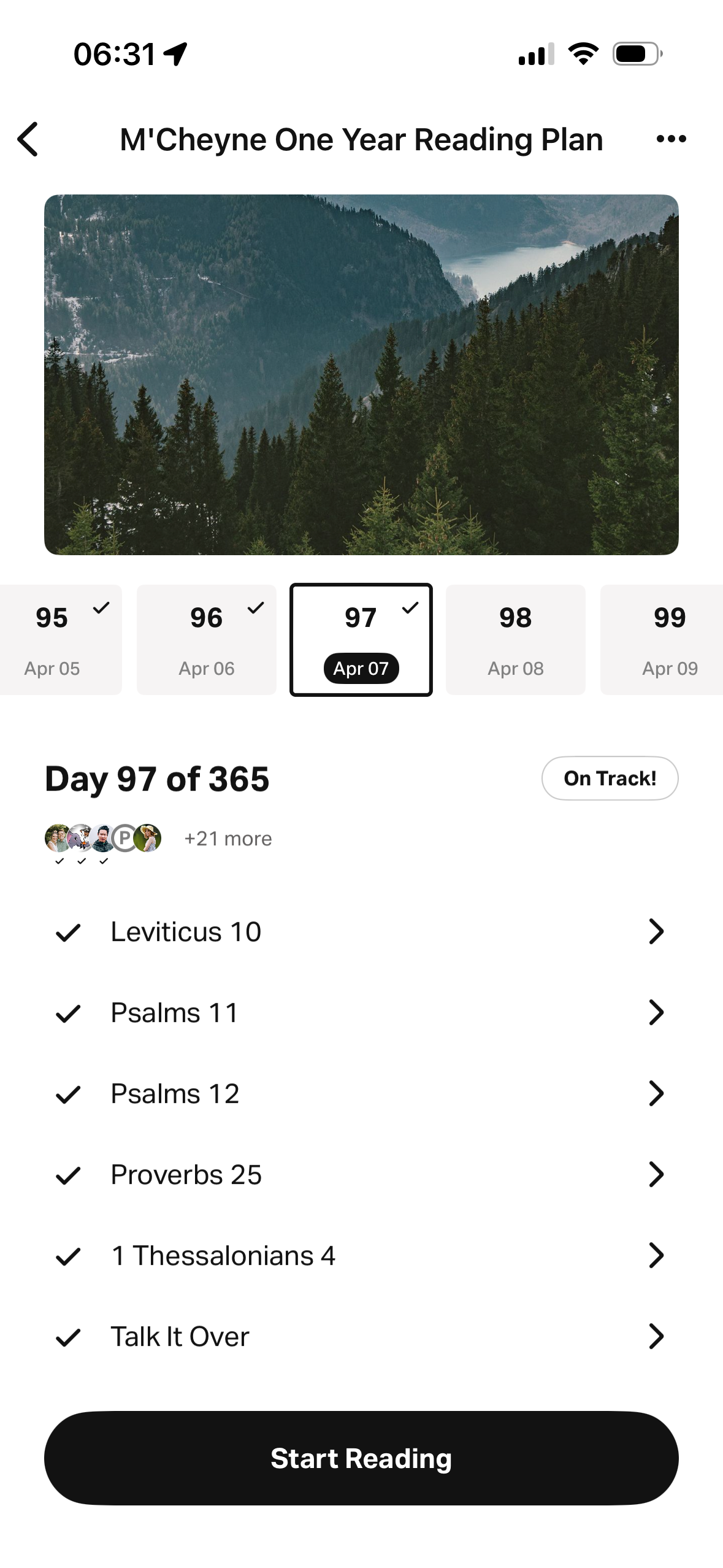
Today is day 97 in our Bible reading plan that our church started at the beginning of the year. That means we’re approaching the end of the first hundred days of 2026, and I have a few reflections on the past one hundred days of reading the Bible to start the year in 2026.
As a teenager and a child, I remember reading the Bible often. Yet, daily Bible reading was never a practice I consistently maintained in my adolescence. I was consistent in church, Sunday school, and Bible class at my local Christian school, but it wasn’t until I was in college and seminary that daily Bible reading became much more prevalent in my life.
Even in Bible college, daily devotional Bible reading wasn’t consistent because much of my academic work involved the Bible in some way, shape, or form. Thus, devotional reading was unfortunately often mixed with academic requirements.
But, toward the end of my time at Bible college, as I stepped into ministry both with a traveling ministry team and then in the local church, I began to see the essential nature of personal discipleship and communion with the Holy Scriptures.
Over the past six years, I have developed and sustained a daily, healthy engagement with the Bible. Like everyone, there are days when I miss my readings or push them further into the day I like, but over the past six years, I have developed a consistent space to encounter the Word of God in my own life.
My church promoted a reading plan at the beginning of the year called the M’cheyne Plan. It reads the entire Bible (including the New Testament and Psalms twice) in a year, with four daily readings.
Some encouraging notes:
If you’re doing the M’cheyne plan, you have finished one fourth of the entirety of the plan. We’ve read through half the New Testament already in three months!
Honestly, the first 97 days have gone by really quickly.
I really enjoy reading different portions of the scripture in the same day. Our plan usually has two Old Testament readings from different places, followed by either a poetic reading or a gospel reading, and then finishes with a New Testament reading. The benefit of having multiple readings in the same day instead of just reading chronologically through is that you get to see parallels throughout the Bible as you read each day.
I love reading the Bible chronologically and typically do once a year in a shorter period of time, but reading each day with multiple readings allows you to see the many connected themes that span throughout the entirety of the Bible.
A few days ago, as we were wrapping up the book of Exodus, Moses is outlining for the people of Israel how the offerings and sacrifices that they would make in the new tabernacle would be a pleasing aroma to God. In Philippians, Paul thanked them for being the ones who first and consistently supported him in his ministry and called their gifts a pleasing aroma to God. Seeing these small connections and illusions throughout the text of scripture is a helpful practice as we more fully understand the meaning of scripture.
It’s fun to see several of us reading the scriptures collectively. Several people in our church are reading through this plan together, and we can see the progress we are making collectively as a group. Here’s my encouragement to you: if you’re behind, skip ahead, join us where we’re at today, and don’t fall into the trap of shame and condemnation. Rather, experience the joy-giving life that walking through the scriptures with others brings.
Building up a practice of being in the scriptures daily takes time, consistency, and discipline. I’m currently reading Henri Nouwen’s book Spiritual Direction, a collection of his lifelong work published after his death. He had this to say on spiritual discipline: “Spiritual disciplines are the skills and techniques by which we begin to see the image of God in our heart.” (P.17) “A spiritual discipline is a way of creating some open and free space in which God can move and speak.” (P.21).
Reading the Bible is a discipline. It takes a lot of commitment and hard work to build up that practice. Yet it is essential for the formation of the Christian life. No good thing is formed in the Christian life without discipline. Nouwen also said this in Spiritual Direction: “Resistance [to the formation of our lives into the likeness of Jesus] in the form of preoccupation and distraction often prevents us from seeing the truth of our lives, hearing God’s voice, and living a spiritual life. To listen with obedience to the voice of God requires building up a resistance to all other voices that compete for our attention.” (P.19) Most Christians have no problem with intention. Their problem lies in discipline. We must force ourselves to remove and ignore the other influences in our lives so that God can form us into his likeness. That is why it is essential to commit to daily Bible reading—along with other disciplines such as prayer, fasting, community, meditation, etc.
When you read the Scriptures consistently, you notice how the practice forms you over time. Being almost a fourth of the way through the entirety of the scriptures, when you look back, it’s easy to see how attainable and achievable it is to engage the Bible.
If you haven’t joined us yet, there’s still time.
CLICK HERE TO JOIN OUR PLAN! When you join, simply click “catch up” so you join us on day 98!